vitababy

The transition from a baby who happily gulps down every spoonful of puree to a toddler who treats a piece of broccoli like a personal insult is one of the most jarring shifts in early parenthood. If you have spent the last twenty minutes pleading with a two-year-old to take just one bite of chicken, you aren’t alone. Food refusal is not just a common phase; it is a complex intersection of biology, psychology, and developmental milestones.
To navigate this period without losing your mind — or your appetite — it helps to understand that for most toddlers, refusing solid foods isn’t about being “naughty” or stubborn. It is often a sign that their body and brain are doing exactly what they were designed to do at this age.
The Biology of the “Toddler Appetite Drop”
One of the most frequent reasons parents worry is the sheer volume of food consumed — or rather, the lack of it. During the first year of life, an infant’s growth is explosive, with the average baby gaining about 7 kg. However, as children enter their second year, their growth rate slows down significantly.
Between the ages of two and five, weight gain typically drops to just 1 kg to 2 kg per year. Because they aren’t growing at a lightning pace anymore, their caloric needs naturally decrease. Many parents mistake this physiological drop in appetite for a refusal to eat, leading to unnecessary pressure that can actually worsen the behavior. According to NIH clinical perspectives on picky eaters, healthy children have a remarkable capacity to self-regulate their energy intake if offered a variety of nutritious foods.
Understanding Food Neophobia
Around 18 months to 2 years of age, many children enter a developmental phase known as “food neophobia” — an evolutionarily ingrained fear of new or unfamiliar foods. In the wild, this served as a protective mechanism to keep mobile toddlers from wandering off and eating poisonous berries or plants.
In the modern dining room, this manifests as a child who suddenly rejects a food they loved last week because it looks “different” or because a stray piece of parsley has “contaminated” their mashed potatoes. This sensitivity to visual appearance is a hallmark of this age. A toddler might reject a piece of toast simply because it has a brown patch or refuse a mixed dish like lasagna because they can’t clearly identify the individual ingredients.
Good to Know
Toddlers have an amazing internal “hunger center” that helps them maintain energy balance over time; even if they eat almost nothing at lunch, they often make up for it by eating a larger dinner or a bigger breakfast the next day, provided they aren’t filling up on excess juice or milk in between.
The Quest for Autonomy
Toddlerhood is defined by the struggle for independence. As toddlers realize they are separate individuals from their parents, they look for ways to exert control. Since you cannot physically force a child to swallow, the dinner table becomes the ultimate arena for autonomy.
If a child feels pressured, bribed, or forced to eat, their need for independence will often drive them to resist even harder. This is why experts from West Suffolk NHS Foundation Trust suggest that allowing toddlers to feed themselves and providing them with limited choices — such as “Do you want carrots or peas?” — can help satisfy their need for control while keeping you in charge of the menu.
Common Culprits: Milk Dependency and Grazing
Sometimes, the reason a toddler refuses solid food is simple: they aren’t hungry. This is often caused by two common habits:
1. The Milk Trap
Milk is nutritious, but it is also very filling. If a toddler is drinking more than 16 to 20 ounces (about 500 mL) of milk per day, they may be meeting their caloric needs through liquid alone. This sets up a cycle where the child rejects solids because they aren’t hungry, and the parent “rescues” them with a bottle or cup of milk to ensure they’ve had something, which then ruins their appetite for the next meal.
2. Constant Grazing
Allowing a child to “pick” at snacks throughout the day prevents them from ever feeling true hunger. For a toddler to be successful at mealtimes, they need to arrive at the table with an appetite. Establishing a routine of three meals and two to three planned snacks is more effective than allowing an all-day buffet.
Practical Strategies for Success
If you are currently in the thick of food refusal, these evidence-based strategies can help lower the temperature at mealtimes:
- The “Safe Food” Rule: Always include at least one food on the plate that you know your child accepts. This reduces their anxiety and ensures there is something they can eat without feeling pressured to try the “scary” new food.
- Repeated Exposure: It can take 10 to 15 — and sometimes up to 20 — exposures before a child is comfortable enough to even taste a new food. Don’t give up after two or three attempts.
- Food Chaining: This is a gentle technique of introducing new foods that are very similar to foods they already like. If they like plain white crackers, try a different shape of cracker, then a different brand, and eventually move toward thin slices of toast.
- Messy Play: Research from the NHS regarding oral aversion shows that playing with food away from mealtimes can reduce sensory sensitivities. Let them touch, smell, and “paint” with yogurt or mashed vegetables in a low-pressure environment.
- The 20-Minute Limit: Mealtimes should not be an endurance test. If a child hasn’t eaten after 20 minutes, calmly remove the plate without anger or frustration.
When to Seek Professional Help
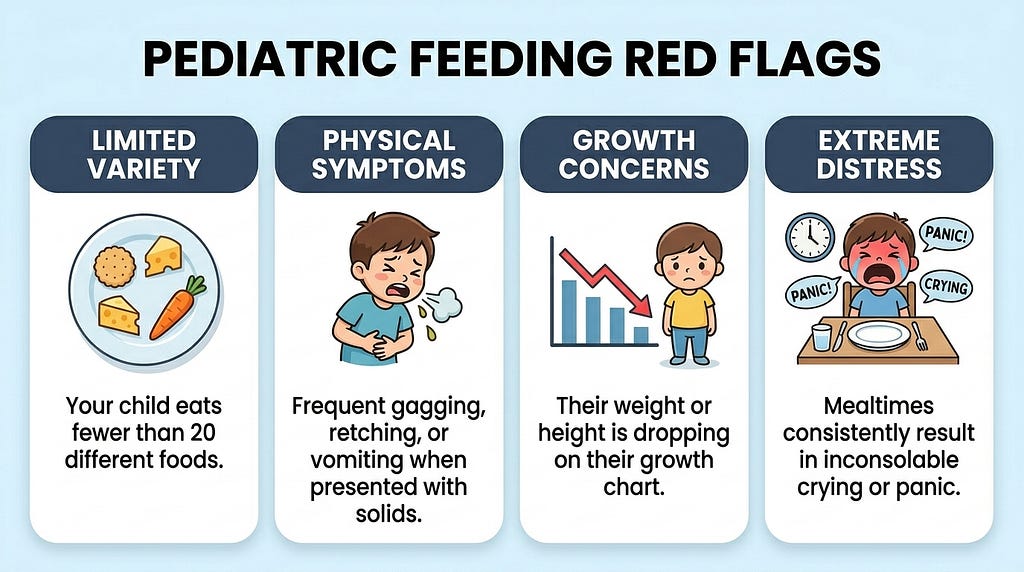
While most fussy eating is a normal developmental phase, some children experience “extreme picky eating” or sensory processing issues that require intervention. You should consult a pediatrician or a registered dietitian if your child:
The Golden Rule: Pressure-Free Feeding
The most important thing to remember is that your job is to provide nutritious food, and your child’s job is to decide whether to eat and how much. When we remove the pressure, mealtimes stop being a battleground and start being a place for exploration. It may take time, and there will be many “windy” or “picky” weeks along the way, but with patience and a structured approach, most children eventually find their way to a diverse and healthy diet.
Originally published on Medium.